How Andromeda uses Alloy to automate L1 and L2 robot support
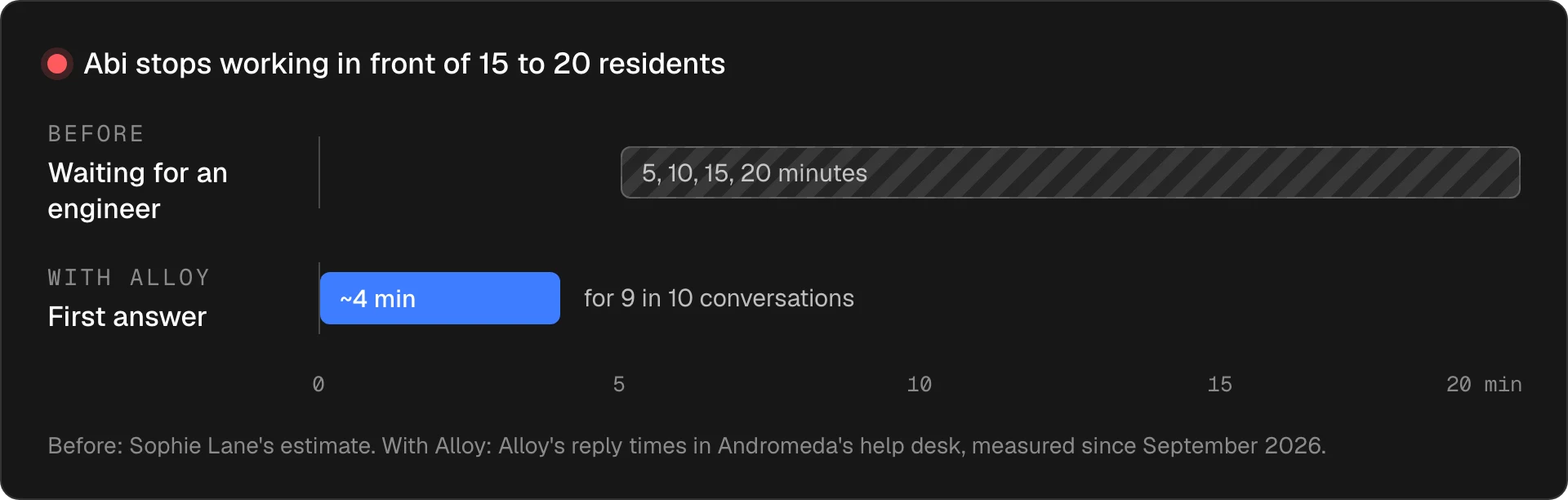
When Abi stops working in front of a room of aged care residents, Alloy answers first, in about 4 minutes instead of the 20 an engineer could take. It now handles around 200 help desk conversations a week.
The hypothesis going in for me was a lot of L1 and L2 level supports can be replaced with agents. And that was proven true over the course of the pilot.Yan Chen, Co-founder and CTO at Andromeda
Impact at a glance
| Before Alloy | With Alloy | |
|---|---|---|
| Investigation setup on one fleet-wide audio bug | ~2 days | ~10 minutes |
| Field's wait for a first answer | 5–20 minutes | ~4 minutes |
| Log trawling before an engineer starts | 10–20 minutes | Done before they arrive |
| Who answers the help desk first | The engineer on duty | Alloy, ~200 conversations a week |
Before: as reported by Andromeda engineers Tom Cameron and Sophie Lane. With Alloy: from Alloy's help desk data.
When Abi needs help in the field, Andromeda's help desk used to wait for an engineer. "Our engineer would respond first and help out," said Sophie Lane, HRI and AI Engineer at Andromeda. "Now Alloy is the first to respond and help out."
Who is Andromeda?
Andromeda builds Abi, a humanoid companion robot for residential aged care. Many residents get few visitors, and some no longer speak English. Abi can play their favourite music from the '50s and '60s, speak their native language and simply chat with them. "Andromeda is all about creating the future of technology with care, compassion, empathy at its core," says Sophie.
The company works from Melbourne and San Francisco, and raised a A$23 million Series A led by Forerunner Ventures. Its co-founder and CTO, Yan Chen, says the core thesis is "to build this social intelligence layer for robotics." That puts a high bar on support.
When you're out in the market, the customer's problems are your problems.Yan Chen, Co-founder and CTO at Andromeda
What breaks when a robot fleet scales?
Andromeda's customer success team takes Abi into care homes for sessions with residents. When something goes wrong mid-session, they need an engineer's help, and they ask for it in a help desk channel in Slack. Sophie spent about a year as a customer success engineer before moving into engineering, so she knows that moment well.
I know how hard it can be with Abi up in front of 15, 20 residents, and she stops working. She stops responding, something weird is happening, and that can be so challenging. And in the past when it was engineers who had to respond in the help desk, if you didn't get a response for 5, 10, 15, 20 minutes, that's really hard to manage that customer relationship.Sophie Lane, HRI and AI Engineer at Andromeda
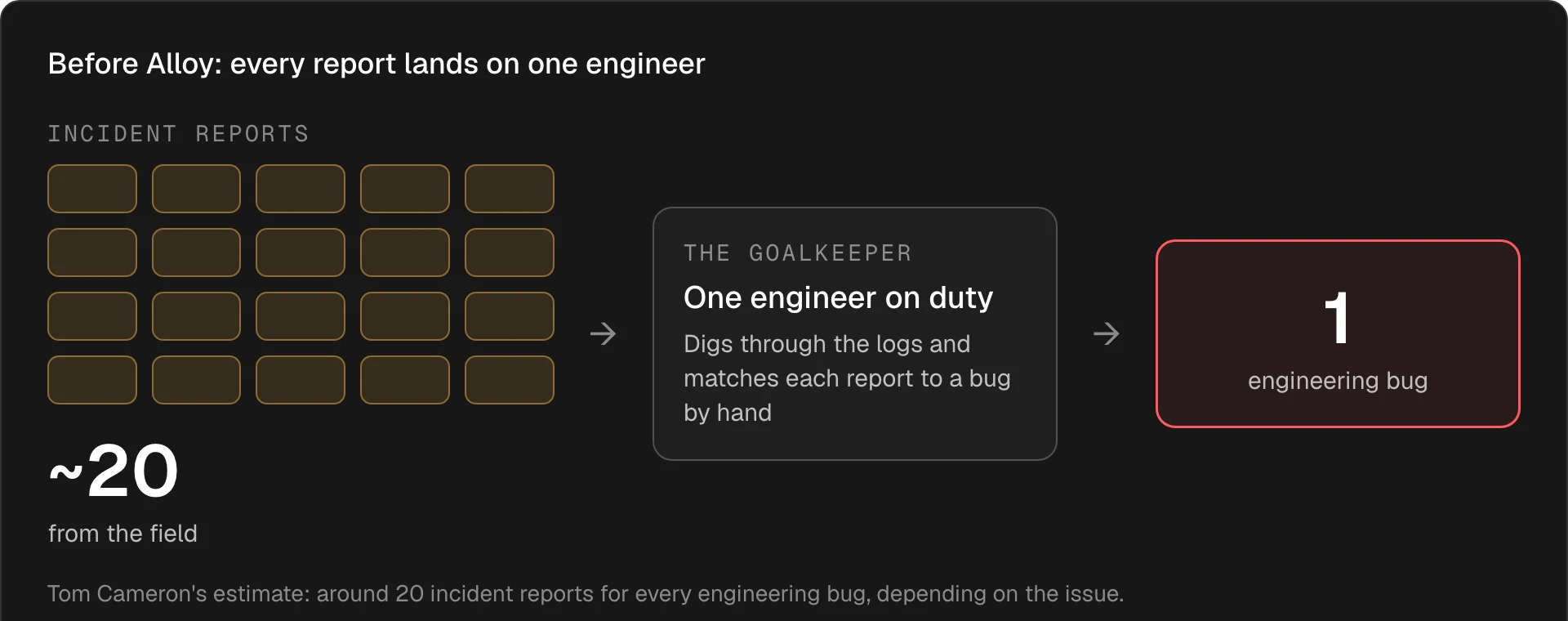
The engineer on duty is called the goalkeeper. "The engineer tends to get nothing else done for the day," said Tom Cameron, Tech Lead, AI Engineering. "We call them the goalkeeper because they're stopping all the shots from hitting the rest of the engineering function." The goalkeeper digs through Grafana logs to answer the field, then matches each Jira ticket to an engineering bug. Tom estimates around 20 incident reports trace back to each engineering bug.
Then the fleet took off.
We had a period of time where we were working on a very large feature, and so we stopped doing releases for about a month and a half, and in that month and a half, our fleet size quadrupled or quintupled. And when we started doing releases again, we immediately had waves and waves of bugs.Tom Cameron, Tech Lead, AI Engineering at Andromeda
Robots were being used about 25 times more each week, so bugs that once took weeks to surface now turned up far sooner. That growth was the goal. The goalkeeper took the strain.
Goalkeeper used to be a week-long responsibility. It became two days after. It just became mentally exhausting to handle that. So scaling was a massive bottleneck.Tom Cameron, Tech Lead, AI Engineering at Andromeda
The job also demands context: the health of the latest release, and any beta software in the field. As Andromeda grew, that got harder to keep up with, even for its longest-serving engineers. "I certainly don't have it today," Tom said.
What does Alloy actually do?
"Where Alloy helps us the most is in our Slack channels," Sophie said. "If their Abi isn't working and they need her to work right now, that's where they put the issue, and Alloy responds directly there."
Alloy is connected to Andromeda's Grafana telemetry, GitHub and Jira, so its answers point back to the logs, code and tickets behind them. Each reply speaks to two audiences in one thread. "We've worked with the Alloy team to end up with a support agent that says, 'Hey, member in the field, here's what I need you to do, please,' and then has separate messages for the engineers," Tom said.
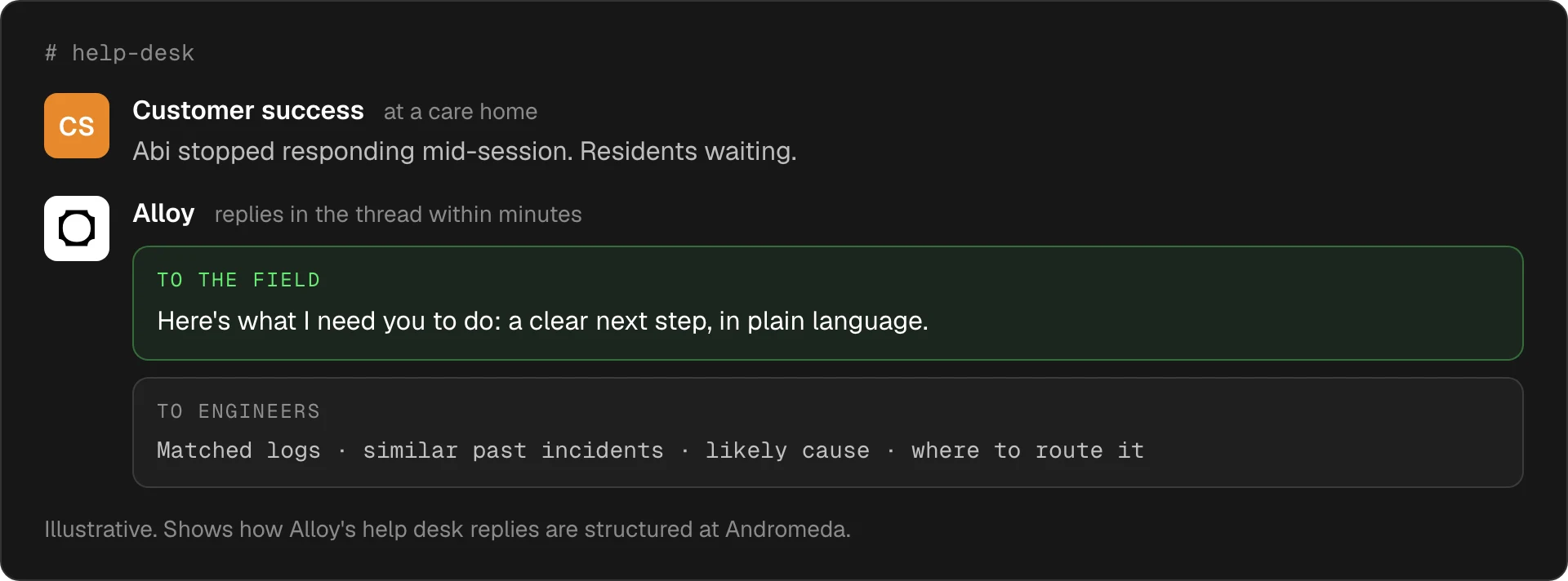
For the field, the change is simple: someone always answers. "Having Alloy be able to come in within a few minutes reliably every single time, because it's an agent, not a person, really helps our customer success team feel like there's at least something that they can lean on," Sophie said.
For engineers, the first pass is done. Tom says people without deep knowledge of Abi's internals can now triage routine incidents themselves. And when an engineer does step in, they start from the evidence.
An engineer can come in already hitting the ground running: "Oh, I know what this is now because Alloy's shown me what the logs are." Whereas usually that would take another 10, 15, even 20 minutes to just trawl through the logs.Sophie Lane, HRI and AI Engineer at Andromeda
Alloy also looks across the whole fleet, which no single ticket can. Sophie remembers the first time it connected an issue she was chasing on one Abi to others. "Alloy actually showed me, 'Hey, this has happened on several different robots at several different time points,'" she said. "We actually had no idea it was really there."
At one care home with patchy Wi-Fi, Alloy built reports showing where the signal was weak, why, and which access points the robots were reaching. It also sorts help desk issues by category, so the team can see which parts of Abi affect her reliability most. In Sophie's words, "It enables us to target the right things in our engineering work day to day."
Yan sees the effect across the company. "What's been really good is the velocity that the rest of the team gets," he said. "There's a lot less thrash with the engineering org." And for customer success, he says, "they've gotten a lot faster feedback and a lot faster resolution as a result of the Alloy agent."
Is it hard to set up?
"When Alloy came on board, it was pretty much just, 'Oh, give us access to your logs and these information buckets and these connectors,'" Yan said. "It was pretty seamless."
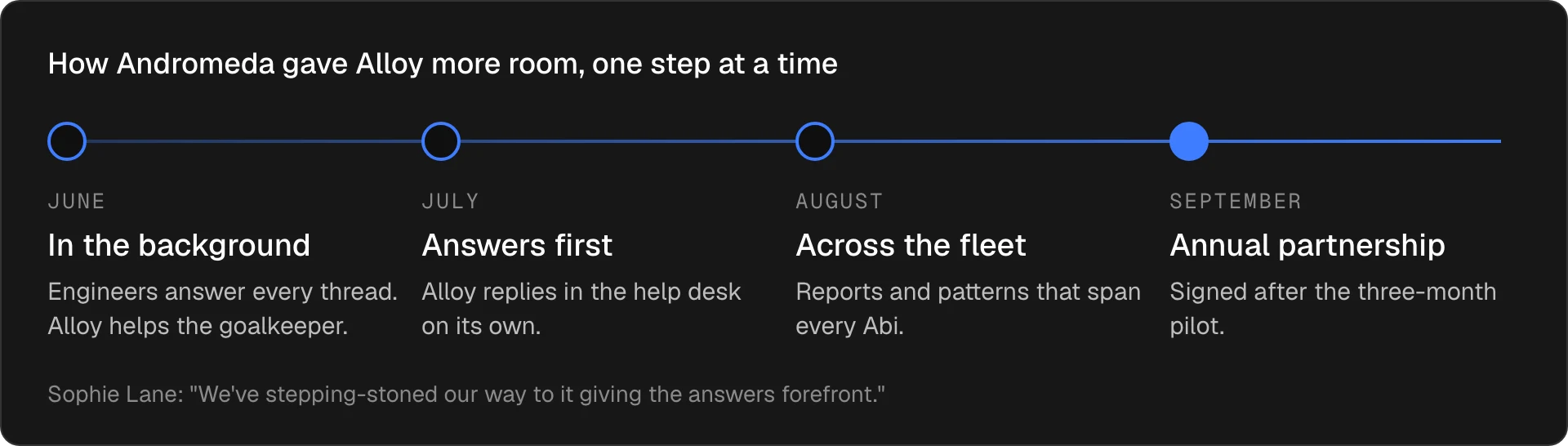
The pilot kicked off on 4 June 2026. A week later, Alloy was running its first live investigations in the help desk. By 20 July, it was answering field issues on its own. In its first two weeks doing so, it gave a first answer on 57 of 58 field faults.
Alloy runs in a dedicated environment for Andromeda. Connecting Grafana, Slack, GitHub and Jira was standard work, Tom said. "The bigger element of getting set up to use Alloy was actually figuring out how to use it as part of that support process." The Alloy team did that fitting with Andromeda, shaping how the agent writes and when it steps in.
Can you trust it?
Tom came in sceptical. "If you have a fair bit of AI in the process, and AI can hallucinate, it can make mistakes, so building up trust is a slow process," he said.
Alloy answers that with evidence. Every reply points back to the logs, code and tickets behind it, so engineers can check its work. "It can give enough information so that the engineers feel satisfied and are trusting Alloy's output because they can look at the output and go, 'Yep, that makes sense to me as an engineer,'" Sophie said.
Andromeda also let Alloy earn its place. "In the beginning, it was just kind of there in the background," Sophie said. "We've stepping-stoned our way to it giving the answers forefront so that our engineers can come in with a really good foundation." The team gives it more room over time, deliberately, "so that we keep the trust high."
Tom also worried that leaning on an agent would weaken the team's habit of building dashboards. What he found instead is that Alloy keeps pace as Andromeda builds out its own monitoring. "It covers the next gap and the next gap from there as we improve," he said.
How do engineers use it?
Sophie triages tickets in batches by DM-ing Alloy in Slack. "Instead of me going through the logs for each one now, I just fire off five at a time," she said. Tom, the sceptic, now works the help desk differently.
I'm habitually waiting for Alloy to jump in first before actually responding myself.Tom Cameron, Tech Lead, AI Engineering at Andromeda
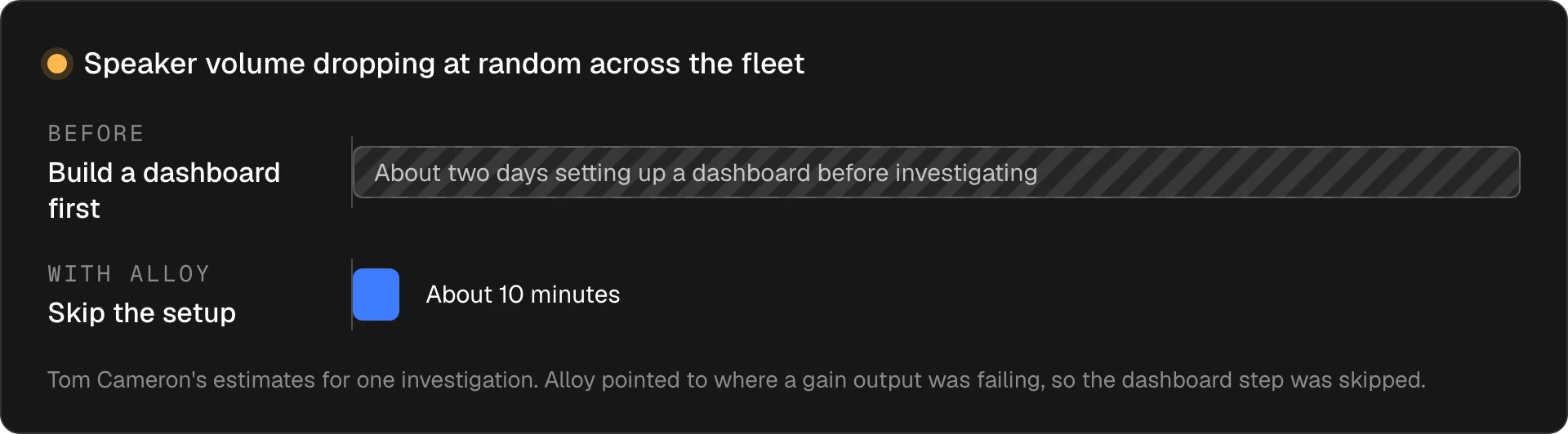
"I don't think I could handle the throughput of bugs that do come through without it as effectively," he said. When speaker volume started dropping at random across the fleet, with no obvious cause, Tom would normally have spent two days building a dashboard across the audio stack. Instead, Alloy pulled the telemetry together, reached for signals he might not have, and pointed to where a gain output was failing. "Alloy skipped that entire step where I would've set up this dashboard," Tom said. It "turned two days into 10 minutes."
That leaves time for the hard problems. "When a bug is truly novel, I can spend hours or days hunting it down rather than having to go classify everything the moment it hits my desk."
Why not build it yourself?
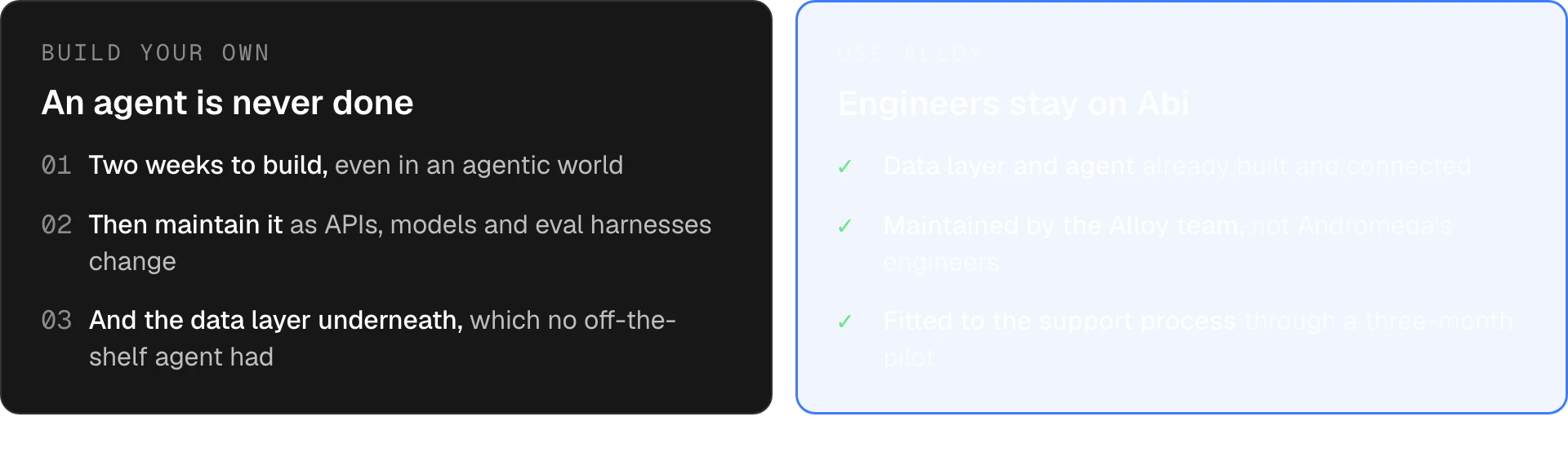
Andromeda builds plenty of its own tools, including its own agents for IT. Yan looked at building this one too, and tried OpenClaw, NanoClaw, Hermes and NVIDIA's agents. "They were missing the layer below, which is the actual concrete data layer that no one had," he said. Even an agent that takes two weeks to build then needs maintaining as APIs, models and evaluation harnesses change. For Yan, it came down to focus: is Andromeda a tooling company, or a products company?
You can be everything, but then as a startup, you will be nothing.Yan Chen, Co-founder and CTO at Andromeda
Was it worth it?
Within a month, 18 of 21 people across software, hardware and customer success were using Alloy. After the three-month pilot, Andromeda signed an annual partnership. The teams are now extending Alloy to hardware triage. Yan wants it to reach the whole company, so that "someone from finance, someone from customer success, they can all talk and use this agent as if another engineer was beside them."
Asked what he would tell another robotics CTO, Yan put the value plainly.
The amount of money or time that we're saving or the amount of focus that we can put into what we're best at is unparalleled.Yan Chen, Co-founder and CTO at Andromeda
"At the end of the day, it's about who you trust," he said. Get that right, and "you'll see the ROI pretty quickly."
Tom came in "dubious about the role of agentic support," in his words. He came out with a clear verdict for other teams: "Not exploring that space is doing yourself a disservice."
Automate your L1 and L2 robot support
Book a demo to see how Alloy can answer your help desk first, the way it does for Andromeda.
book a demo