How SwarmFarm is scaling its robot fleet without hiring more support engineers
SwarmFarm has close to 300 autonomous robots working on farms across Australia. Alloy lets its support capacity grow with the fleet, not with the engineering team.
Last year around this time, I was probably spending at least a day or more investigating issues and support tickets. At the moment, it's usually less than an hour here and there.Mitch Galea, Senior Autonomy Engineer at SwarmFarm
Impact at a glance
- A day or more → under an hour: Mitch's own estimate of his time on support investigations, a year apart
- About a week: from connecting Alloy to SwarmFarm's telemetry to the first results
- 25 people: using Alloy across engineering, support and customer success
- No new support engineers hired yet: even as the fleet keeps growing
SwarmFarm's robots are working farms across Australia
SwarmFarm builds autonomous vehicles for agriculture. Close to 300 of its robots are in commercial work on farms right across Australia. Every farm brings its own conditions, crops and jobs, so the fleet sees an enormous range of situations. In late 2025, SwarmFarm raised a A$30 million Series B to scale its fleet and expand into North America.
Summer is peak season. The number of robots out working climbs from tens to hundreds, and requests from farmers climb with it. Over the past year, SwarmFarm's team handled close to 3,000 support requests, with more than 300 a month through the summer peak.
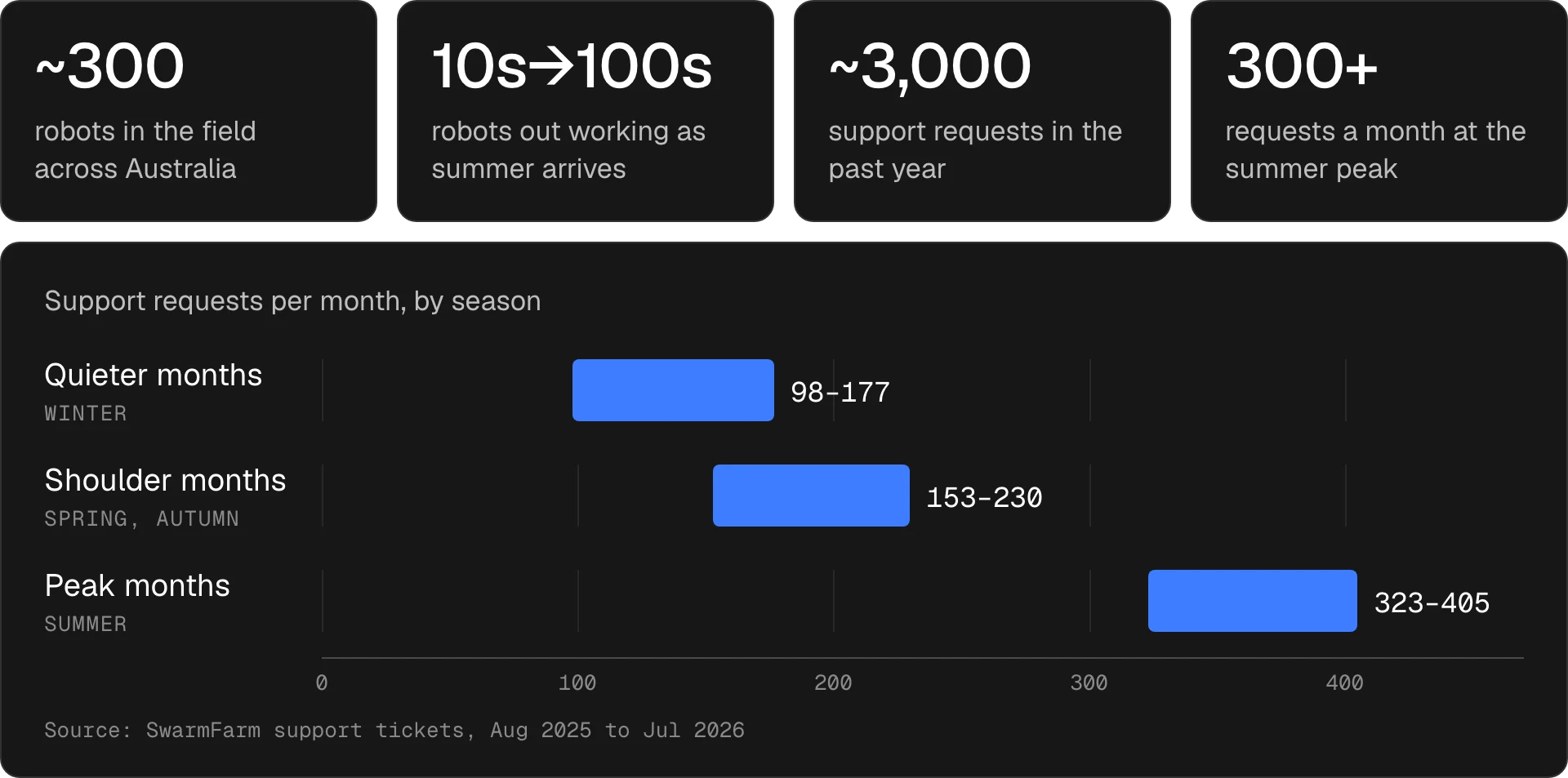
That growth is the goal, and it brings a challenge every robotics company meets as it scales deployments. More robots in the field means more questions from the field. The hardest ones land with the engineers who know the robots best, and the roadmap starts competing with the ticket queue.
More robots in the field, more questions for engineering
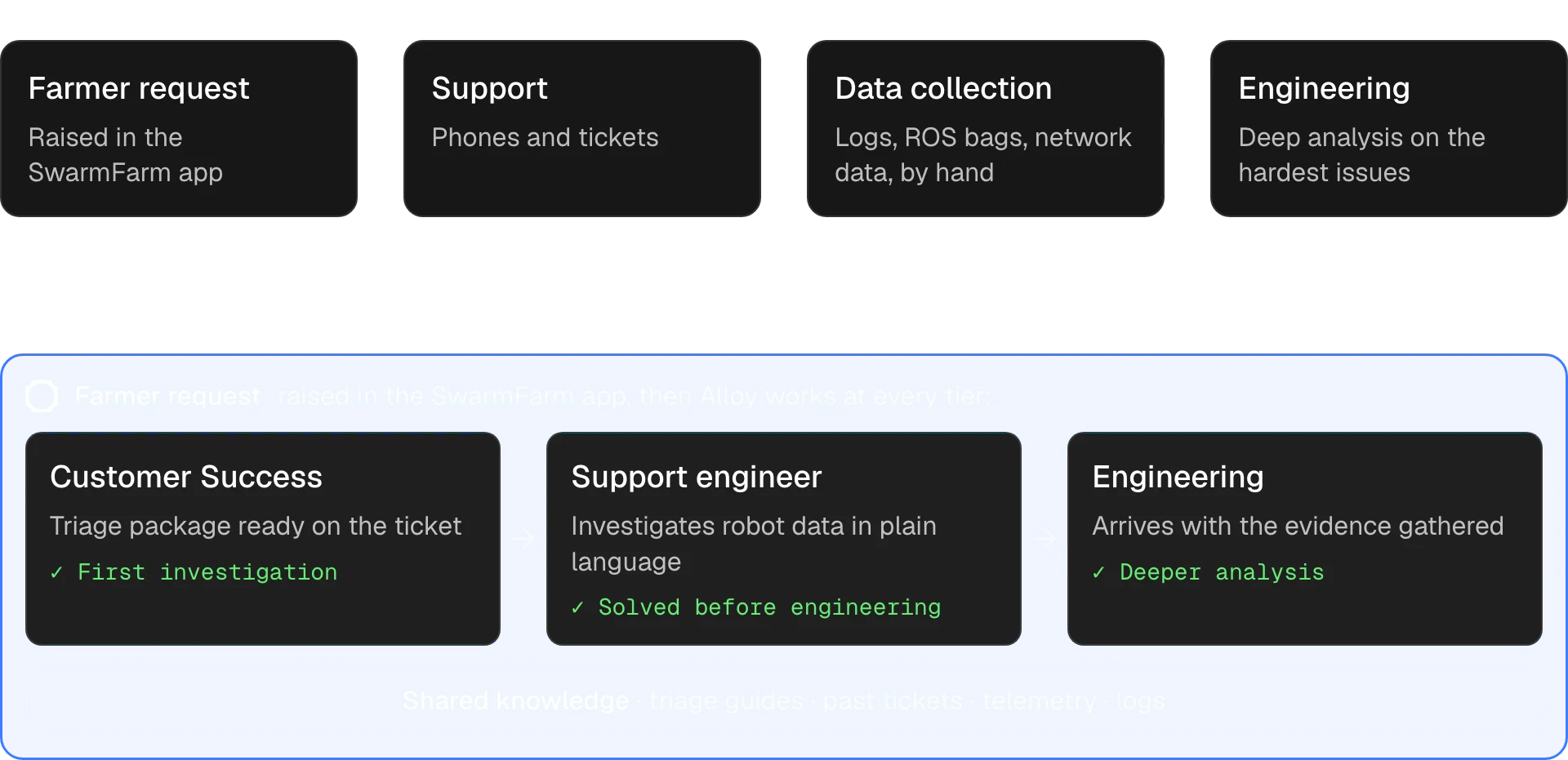
SwarmFarm's support process was thorough. When a farmer needed help:
- The farmer raised a request through the SwarmFarm app.
- Support built a full picture from the robot's telemetry, because farmers are busy running their farms and reports vary in detail.
- Support gathered logs, ROS bags and network data, and often called the farmer back to understand exactly what happened.
- Harder issues went to SwarmFarm's autonomy engineers for deeper analysis.
- The ticket closed once the team had a confirmed answer.
That's careful work, and it takes time. Some investigations took a few hours, others up to a week, and the hardest ones competed with product work for engineers' attention. Field robots also keep limited logs on board, so in peak season, speed matters: older logs roll over to make room for new ones.
Rather than wait for summer to arrive, the team used the quieter months to get ahead of it.
We've used this winter period to try to prepare, put in place some better systems, keep on top of the incoming issues that occur when we have much more robots running.Mitch Galea, Senior Autonomy Engineer at SwarmFarm
Why SwarmFarm bought instead of built
Mitch found Alloy himself. He uploaded a single ROS bag file to try it, liked the plots that came back, and got in touch with the Alloy team shortly after.
SwarmFarm had the skills to build its own tools, and considered it. "But really it's a question of manpower," Tom Brodie, SwarmFarm's Head of Autonomy, said. "We got enough people with enough busy plates."
Mitch saw the same trade-off. "I could set something up and get it working well enough for me," he said. "But to support a whole team, and having to then answer all their questions, that wasn't gonna be maintainable long term."
Tom put it simply: "We build robots. We don't wanna build diagnostic websites. So why reinvent the wheel?"
Alloy connected first to ClickHouse, where SwarmFarm keeps its robot telemetry. Once the whole team could query that data through Alloy, the value was immediate. "I thought it was gonna be a lot longer," Tom said. "It was like a week." Jira, Confluence, Slack and SwarmFarm's CAN API followed, so Alloy could read tickets, triage guides and decoded robot data in one place.
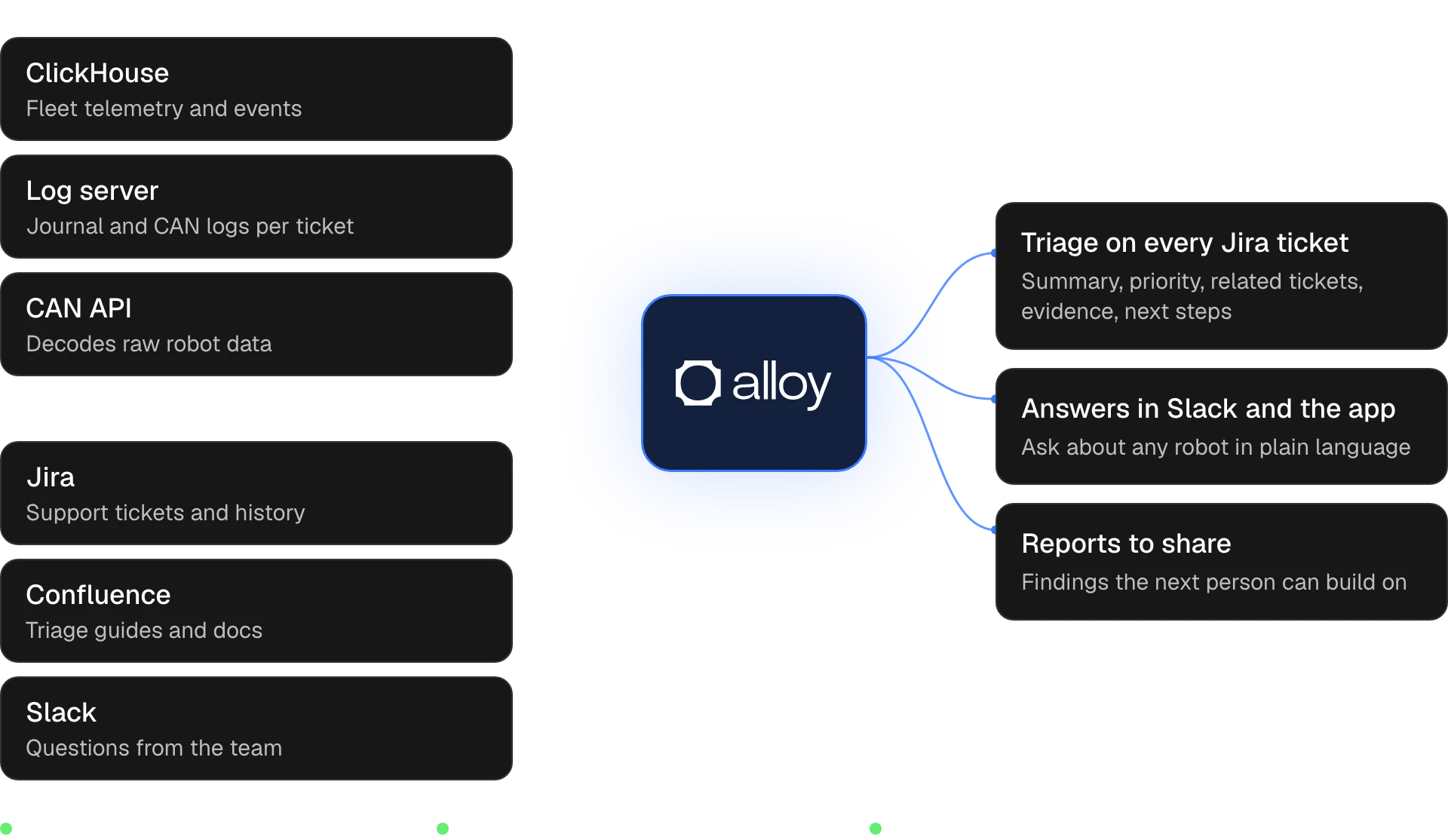
Every new ticket arrives with a first investigation
When a ticket lands in SwarmFarm's Jira, Alloy builds a triage package before a person picks it up:
- It summarises the issue and flags any missing context.
- It suggests a priority and a route, based on SwarmFarm's own triage guide.
- It finds related tickets, and searches the robot's telemetry and logs.
- Where logs will help, it requests them from the robot.
- It posts its findings as an internal comment, for a person to review and act on.
Alloy works from SwarmFarm's own triage guides, past tickets and documentation, so it follows the way SwarmFarm's experts already work.
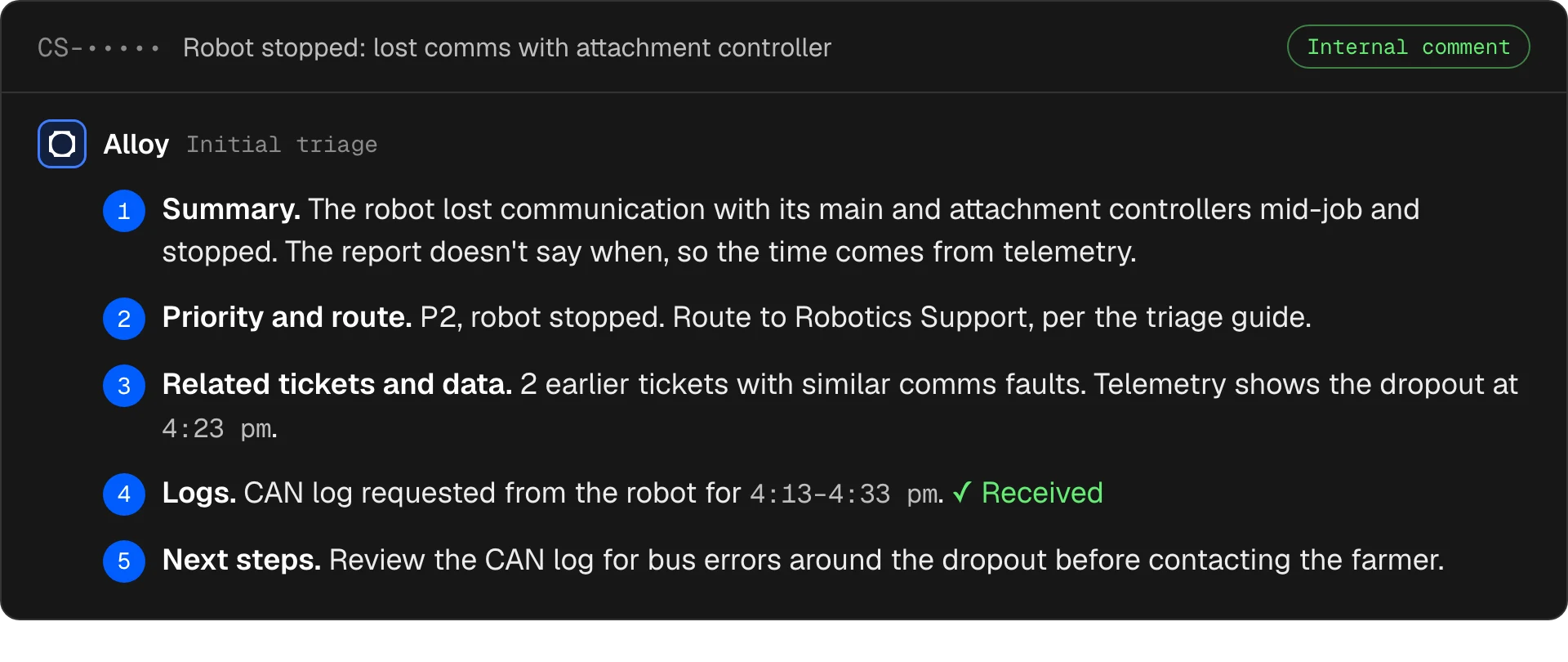
On one ticket about a communication fault between a robot's main and attachment controllers, Alloy found the exact time window and requested the right CAN logs from the robot on its first review.
For the people on the phones, that takes care of the most repetitive part of the job.
I was on the phones last week, I really noticed that helped me a lot. Just took half my job away from me. Just that silly stuff you have to do.Luke Reid, Robotics Support Specialist at SwarmFarm
SwarmFarm has also been building out its support structure, adding a support engineer role between customer success and the full engineering team. Alloy works at every tier, and goes into more detail as an issue moves up. In one winter week, it ran about 95 triage investigations on tickets and answered 235 questions from the team. Engineers used it most, because that's where the hardest problems land.
Answers that come with evidence
Trust in an AI agent is built in drips and lost in buckets. Tom said Alloy "gives you the ability to not just make claims, but to be able to back them up." Its findings point back to the tickets, telemetry and logs behind them.
Alloy doesn't act alone. It posts internal comments for the team to review, and people stay in charge of what goes back to farmers.
SwarmFarm's team keeps it sharp. On one ticket, Alloy suspected a software version regression. A SwarmFarm engineer pointed out that the beta had already gone into production. Alloy withdrew the claim, reviewed related tickets for the same robot, and proposed a better line of investigation into power and brownouts.
It's a lot better than sort of other platforms and things that I've seen, like AI summarizing agents and stuff like that.Jack Humphrey, Customer Success Team Lead at SwarmFarm
Support solves more before it reaches engineering
Farmers are busy running their farms. When they report an issue, they might say it happened "maybe an hour ago." Alloy finds the exact moment in the robot's data, so support pulls logs for a narrow window instead of a large one. "That really short-circuits the whole process," Mitch said.
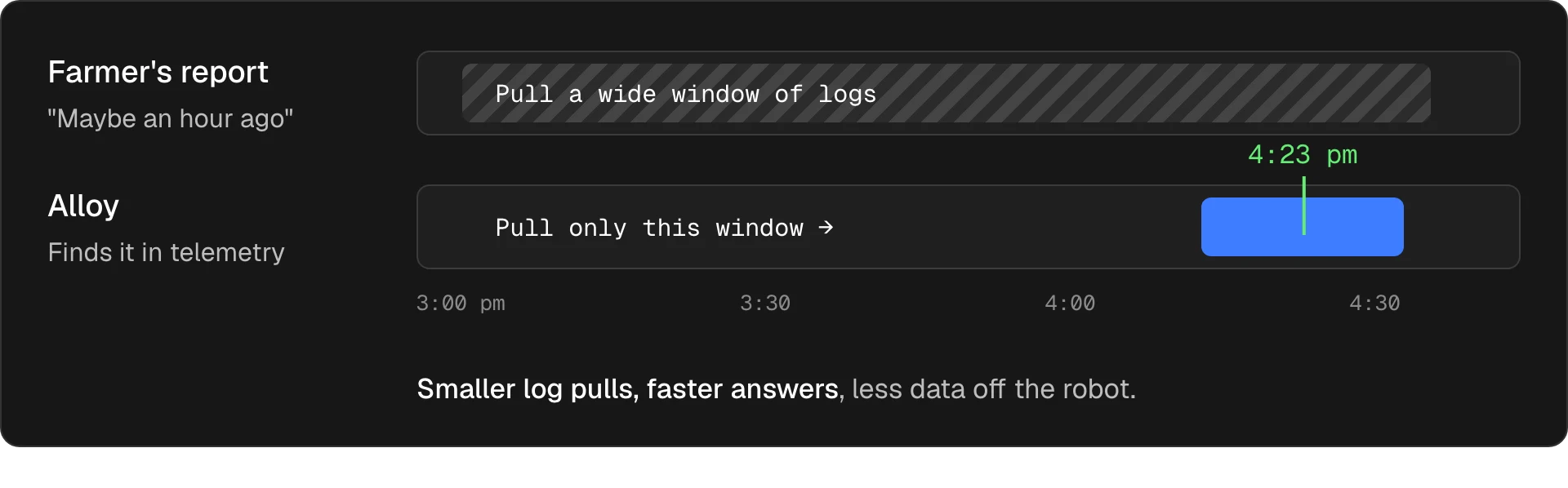
When an issue does go to engineering, the evidence is already gathered. Farmers hear back sooner, too. Support can often tell them early that the team has seen something similar and knows where to look.
Every engineer gets the best engineer's context
As SwarmFarm's senior engineers work with Alloy, their know-how stays with it: which signals to check, and, in Tom's words, "where to look again, given a repeated flow." That puts deep investigation within reach of the whole team.
When a couple of robots had GPS issues, a recent addition to the team used Alloy to compare their settings. Alloy spotted a configuration difference between them, and the team traced it to what appears to be the root cause. Another new software engineer picked Alloy up in their first week, worked through an issue with a release candidate, and wrote it up as a report for a field technician.
"Basically something that we'd have an engineer do a query for, but some bloke could just work that out," Tom said. "It's really made accessible what was otherwise quite behind a technical barrier."
I reckon everyone feels like they're upskilling. People are having more insights on even topics I'm just like, I don't even know the answer to.Tom Brodie, Head of Autonomy at SwarmFarm
More robots, without more support engineers
"The ticket flows are stopping before us," Tom said. "People are able to solve their own problems."
Mitch gets far fewer escalations. "I definitely don't miss writing all the NumPy and Matplotlib Python scripts," he said. That time now goes into big projects and the core problems the team wants to solve.
SwarmFarm's support engineering team is lean, and it hasn't needed to hire anyone yet. "Alloy's given us a lot more breathing room," Tom said. Mitch put the outcome plainly: "We're not worried about keeping on scaling up robots without having to grow the team."
Simply put, SwarmFarm's support capacity now grows with its fleet. After the pilot, SwarmFarm moved into an annual partnership with Alloy, and every investigation adds to what Alloy knows about its robots. Mitch now wants to add more telemetry to the robots. "Imagine what we can do now that Alloy has access to this data," he said.
We wanna work on robotics. We don't wanna build integrations to LLMs. Using Alloy just frees up all that time so we can focus on what we wanna do.Mitch Galea, Senior Autonomy Engineer at SwarmFarm
See what 10× faster analysis looks like
Book a demo to see how Alloy works with your data.
book a demo